The Ancestors and Zulu Family Transitions: a Bowen Theory and Practical Theological Interpretation
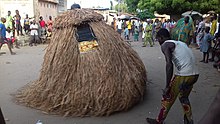
Local African ceremony in Benin featuring a zangbeto.
The traditional beliefs and practices of African people are highly diverse beliefs that include diverse ethnic religions.[1] [ii] Generally, these traditions are oral rather than scriptural and passed down from one generation to some other through folk tales, songs, and festivals,[3] [4] include belief in an amount of higher and lower gods, sometimes including a supreme creator or forcefulness, belief in spirits, veneration of the dead, use of magic and traditional African medicine. Near religions can exist described as animistic[5] [six] with diverse polytheistic and pantheistic aspects.[seven] [1] The function of humanity is mostly seen as i of harmonizing nature with the supernatural.[ane] [viii]
Spread [edit]
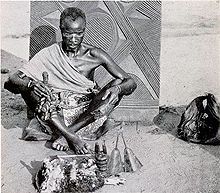
An early on-20th-century Igbo medicine man in Nigeria, W Africa
Adherents of traditional religions in Africa are distributed among 43 countries and are estimated to number over 100 meg.[9] [10]
Although most Africans today are adherents of Christianity or Islam, African people often combine the practice of their traditional beliefs with the practice of Abrahamic religions.[11] [12] [thirteen] [xiv] [15] The two Abrahamic religions are widespread across Africa, though generally full-bodied in different areas. They have replaced indigenous African religions but are frequently adapted to African cultural contexts and belief systems. Abrahamic religious beliefs, especially monotheistic elements, such equally the belief in a single creator god, was introduced into traditionally polytheistic African religions rather early on.[sixteen]
Followers of traditional African religions are also constitute effectually the world. In recent times, religions, such every bit the Yoruba faith, are on the rising. The religion of the Yoruba is finding roots in the Islands of the Caribbean and portions of Fundamental and South America. In the United States, Voodoo is more than predominant in the states along the Gulf of Mexico.[17]
Nuts [edit]
Animism builds the cadre concept of traditional African religions. This includes the worship of tutelary deities, nature worship, ancestor worship and the conventionalities in an afterlife. While some religions adopted a pantheistic worldview, well-nigh follow a polytheistic organisation with diverse gods, spirits and other supernatural beings.[18] Traditional African religions besides have elements of fetishism, shamanism and veneration of relics.[xix]
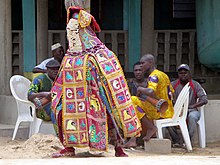
Traditional African, like nearly other ancient traditional religions around the world, were based on oral traditions. These traditions are non religious principles, but a cultural identity that is passed on through stories, myths and tales, from one generation to the next. The community and ones family, just also the surround, plays an important role in one's personal life. Followers believe in the guidance of their ancestors spirits. Among many traditional African religions, there are spiritual leaders and kinds of priests. These persons are essential in the spiritual and religious survival of the customs. At that place are mystics that are responsible for healing and 'divining' - a kind of fortune telling and counseling, similar to shamans. These traditional healers accept to exist chosen by ancestors or gods. They undergo strict training and acquire many necessary skills, including how to use natural herbs for healing and other, more than mystical skills, like the finding of a hidden object without knowing where it is. Traditional African religion believe that ancestors maintain a spiritual connectedness with their living relatives. Nigh ancestral spirits are generally good and kind. Negative actions taken by bequeathed spirits is to cause small illnesses to warn people that they have gotten onto the wrong path.[20]
Information technology is suggested that most ancient traditional African religions, like most other indigenous folk religions around the world, were strictly polytheistic and lacked the belief in monotheistic concepts, such as a unmarried supreme creator god. Native African religions are centered on ancestor worship, the conventionalities in a spirit world, supernatural beings and gratuitous will (dissimilar the later developed concept of faith). Deceased humans (and animals or important objects) still exist in the spirit earth and can influence or interact with the physical world. Polytheism was widespreaded in almost of ancient African and other regions of the world, before the introduction of Islam, Christianity, and Judaism. An exception was the brusque-lived monotheistic faith created by Pharaoh Akhenaten, who made information technology mandatory to pray to his personal god Aton (run across Atenism).[21] This remarkable modify to traditional Egyptian religion was even so reverted by the adjacent Pharaoh of Arab republic of egypt.[22] [23] [24] [25] High gods, along with other more specialized deities, ancestor spirits, territorial spirits, and beings, are a common theme among traditional African religions, highlighting the complex and advanced culture of aboriginal Africa.[25] [26] [27]
Some researchers, including historical ethnolinguist Christopher Ehret, propose that certain monotheistic concepts, such equally the belief in a high god or force (adjacent to other many other gods, deities and spirits) were nowadays within Africa, before the introduction of Abrahamic religions. However these indigenous concepts were substantially unlike from the monotheism found in Abrahamic religions.[28] [29] [25] [30]
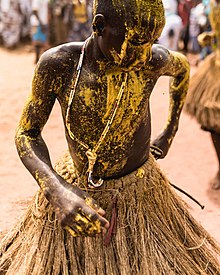
Traditional African medicine is also directly linked to traditional African religions. Co-ordinate to Clemmont East. Vontress, the various religious traditions of Africa are united by a basic Animism. According to him, the belief in spirits and ancestors is the well-nigh important element of African religions. Gods were either self-created or evolved from spirits or ancestors which got worshiped by the people. He also notes that well-nigh modern African folk religions were strongly influenced by non-African religions, more often than not Christianity and Islam and thus may differ from the ancient forms.[31]
Nigerian American professor of ethnic African religions at Harvard Academy, Jacob Olupona summarized the many traditional African religions as circuitous animistic religious traditions and behavior of the African people earlier the Christian and Islamic "colonization" of Africa. Ancestor veneration has ever played a "meaning" role in the traditional African cultures and may exist considered as fundamental to the African worldview. Ancestors (bequeathed ghosts/spirits) are an integral role of reality. The ancestors are mostly believed to reside in an ancestral realm (spiritworld), while some believe that the ancestors became equal in power to deities.[32]
The defining line between deities and ancestors is often contested, just overall, ancestors are believed to occupy a higher level of existence than living human beings and are believed to be able to bestow either blessings or illness upon their living descendants. Ancestors tin can offer advice and bestow expert fortune and accolade to their living dependents, only they can also make demands, such every bit insisting that their shrines be properly maintained and propitiated. A belief in ancestors also testifies to the inclusive nature of traditional African spirituality by positing that deceased progenitors notwithstanding play a role in the lives of their living descendants.
Olupona rejects the western/Islamic definition of Monotheism and says that such concepts could non reverberate the complex African traditions and are too simplistic. While some traditions have a supreme being (side by side to other deities), others have non. Monotheism does not reflect the multiplicity of ways that the traditional African spirituality has conceived of deities, gods, and spirit beings. He summarizes that traditional African religions are not only religions, simply a worldview, a manner of life.[33]
Ceremonies [edit]
West and Central African religious practices generally manifest themselves in communal ceremonies or divinatory rites in which members of the community, overcome by force (or ashe, nyama, etc.), are excited to the bespeak of going into meditative trance in response to rhythmic or driving drumming or singing. 1 religious ceremony practiced in Gabon and Cameroon is the Okuyi, practiced by several Bantu ethnic groups. In this state, depending upon the region, drumming or instrumental rhythms played by respected musicians (each of which is unique to a given deity or antecedent), participants embody a deity or ancestor, free energy or land of mind past performing distinct ritual movements or dances which further enhance their elevated consciousness.[34]
When this trance-like state is witnessed and understood, adherents are privy to a mode of contemplating the pure or symbolic apotheosis of a item mindset or frame of reference. This builds skills at separating the feelings elicited by this mindset from their situational manifestations in daily life. Such separation and subsequent contemplation of the nature and sources of pure energy or feelings serves to assist participants manage and have them when they arise in mundane contexts. This facilitates better control and transformation of these energies into positive, culturally appropriate beliefs, thought, and spoken communication. Too, this practice tin give rise to those in these trances uttering words which, when interpreted by a culturally educated initiate or diviner, can provide insight into appropriate directions which the community (or individual) might have in accomplishing its goal.[35]
Spirits [edit]
Followers of traditional African religions pray to diverse spirits as well as to their ancestors.[36] This includes as well nature, elementary and animal spirits. The deviation betwixt powerful spirits and gods is oft minimal. Virtually African societies believe in several "high gods" and a large amount of lower gods and spirits. At that place are also some religions with a unmarried supreme being (Chukwu, Nyame, Olodumare, Ngai, Roog, etc.).[37] Some recognize a dual god and goddess such every bit Mawu-Lisa.[38]
Traditional African religions mostly believe in an afterlife, 1 or more Spirit worlds, and Ancestor worship is an of import bones concept in mostly all African religions. Some African religions adopted unlike views through the influence of Islam or even Hinduism.[39]
Practices and rituals [edit]
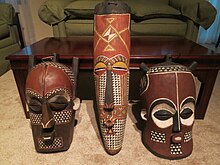
There are more similarities than differences in all traditional African religions.[40] The deities and spirits are honored through cooler or cede (of animals, vegetables, cooked food, flowers, semi-precious stones and precious metals). The will of the gods or spirits is sought by the believer also through consultation of divinities or divination.[41] Traditional African religions encompass natural phenomena – ebb and tide, waxing and waning moon, rain and drought – and the rhythmic blueprint of agriculture. According to Gottlieb and Mbiti:
The environment and nature are infused in every attribute of traditional African religions and culture. This is largely because cosmology and behavior are intricately intertwined with the natural phenomena and environment. All aspects of weather, thunder, lightning, pelting, day, moon, sun, stars, and then on may become amenable to control through the cosmology of African people. Natural phenomena are responsible for providing people with their daily needs.[42]
For case, in the Serer organized religion, one of the most sacred stars in the creation is called Yoonir (the Star of Sirius).[43] With a long farming tradition, the Serer high priests and priestesses (Saltigue) evangelize yearly sermons at the Xooy Ceremony (divination ceremony) in Fatick earlier Yoonir's stage in order to predict winter months and enable farmers to start planting.[44]
Traditional healers are mutual in most areas, and their practices include a religious chemical element to varying degrees.
Divination [edit]

Since Africa is a big continent with many indigenous groups and cultures, there is not 1 single technique of casting divination. The practice of casting may be washed with small objects, such as bones, cowrie shells, stones, strips of leather, or flat pieces of wood.
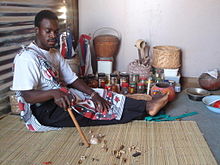
Some castings are washed using sacred divination plates made of wood or performed on the ground (ofttimes within a circumvolve).
In traditional African societies, many people seek out diviners on a regular basis. In that location are generally no prohibitions against the practice. Diviner (also known as priest) are also sought for their wisdom as counselors in life and for their knowledge of herbal medicine.
Ubuntu [edit]
Ubuntu is a Nguni Bantu term meaning "humanity". It is sometimes translated as "I am because we are" (also "I am considering you lot are"), or "humanity towards others" (in Zulu, umuntu ngumuntu ngabantu). In Xhosa, the latter term is used, just is often meant in a more philosophical sense to mean "the belief in a universal bond of sharing that connects all humanity". It is a collection of values and practices that people of Africa or of African origin view every bit making people accurate human being beings. While the nuances of these values and practices vary across unlike ethnic groups, they all point to one thing – an authentic private man being is role of a larger and more significant relational, communal, societal, environmental and spiritual world.[45]
Virtue and vice [edit]
Virtue in traditional African religion is oft connected with conveying out obligations of the communal aspect of life. Examples include social behaviors such as the respect for parents and elders, raising children appropriately, providing hospitality, and being honest, trustworthy, and mettlesome.
In some traditional African religions, morality is associated with obedience or defiance to God regarding the fashion a person or a community lives. For the Kikuyu, according to their primary supreme creator, Ngai, acting through the lesser deities, is believed to speak to and be capable of guiding the virtuous person every bit 1's conscience.
In many cases, Africans who accept converted to other religions take still kept up their traditional customs and practices, combining them in a syncretic mode.[46]
Sacred places [edit]
Some sacred or holy locations for traditional religions include Nri-Igbo, the Point of Sangomar, Yaboyabo, Fatick, Ife, Oyo, Dahomey, Benin Metropolis, Ouidah, Nsukka, Kanem-Bornu, Igbo-Ukwu, and Tulwap Kipsigis, amid others.
Religious persecution [edit]
Traditions past region [edit]
This list is limited to a few well-known traditions.
Fundamental Africa [edit]
- Bantu mythology (Central, Southeast, Southern Africa)
- Bushongo mythology (Congo)
- Kongo organized religion (Congo)
- Lugbara mythology (Congo)
- Baluba mythology (Congo)
- Mbuti mythology (Congo)
- Dinka religion (Due south Sudan)
- Hausa animism (Republic of chad, Gabon)
- Lotuko mythology (Southward Sudan)
East Africa [edit]
- Bantu mythology (Primal, Southeast, Southern Africa)
- Gikuyu mythology (Republic of kenya)
- Akamba mythology (Republic of kenya)
- Maasai mythology (Kenya, Tanzania, Ouebian)
- Kalenjin mythology (Kenya, Uganda, Tanzania)
- Dini Ya Msambwa (Bungoma, Trans Nzoia, Kenya)
- Waaqeffanna (Oromia)
- Waaqism (Somali)
Northward Africa [edit]
- Ancient Egyptian religion (Egypt, Sudan)
- Kemetism
- Punic religion (Tunisia, Algeria, Libya)
- Traditional Berber religion (Kingdom of morocco (including Western Sahara), People's democratic republic of algeria, Tunisia, Libya, Arab republic of egypt, Mauritania, Mali, Niger, Chad, Burkina Faso)
- Hausa animism (Sudan)
Southern Africa [edit]
- Bantu mythology (Cardinal, Southeast, Southern Africa)
- Lozi mythology (Zambia)
- Tumbuka mythology (Malawi)
- Xhosa mythology (Southern Africa)
- Zulu mythology (South Africa)
- San organized religion (S Africa)
- Traditional healers of South Africa
- Manjonjo Healers of Chitungwiza of Zimbabwe
- Ethnic religion in Republic of zimbabwe
Westward Africa [edit]
- Abwoi religion (Nigeria)
- Akan religion (Ghana, Cote d'ivoire)
- Dahomean religion (Benin, Togo)
- Efik mythology (Nigeria, Cameroon)
- Edo religion (Republic of benin kingdom, Nigeria)
- Hausa animism (Republic of benin, Burkina Faso, Cameroon, Ghana, Republic of cote d'ivoire, Niger, Nigeria, Togo)
- Ijo traditional religion (Ijo people, Nigeria)
- Odinani (Igbo people, Nigeria)
- Asaase Yaa (Bono people (found mostly in Ghana), Ghana and Cote d'ivoire)
- Serer religion (A ƭat Roog) (Senegal, Gambia, Mauritania)
- Yoruba religion (Nigeria, Republic of benin, Togo)
- Vodou (Republic of ghana, Benin, Togo, Nigeria)
- Dogon religion (Mali)
African diaspora [edit]
Afro-American religions involve ancestor worship and include a creator deity along with a pantheon of divine spirits such as the Orisha, Loa, Vodun, Nkisi and Alusi, among others. In addition to the religious syncretism of these diverse African traditions, many also contain elements of Folk Catholicism including folk saints and other forms of Folk faith, Native American organized religion, Spiritism, Spiritualism, Shamanism (sometimes including the apply of Entheogens) and European folklore.
Various "doctoring" spiritual traditions also be such as Obeah and Hoodoo which focus on spiritual health.[52] African religious traditions in the Americas tin can vary. They can have non-prominent African roots or can be almost wholly African in nature, such as religions similar Trinidad Orisha.[53]
Notes [edit]
- ^ a b c Encyclopedia of African Religion (Sage, 2009) Molefi Kete Asante
- ^ Ndlovu, Tommy Matshakayile (1995). Imikhuba lamasiko AmaNdebele. Doris Ndlovu, Bekithemba South. Ncube. Gweru,GasiyaZimbabwe: Mambo Printing. ISBN0-86922-624-X. OCLC 34114180.
- ^ Juergensmeyer, Mark (2006). The Oxford Handbook Of Global Religions. ISBN 0-19-513798-1.
- ^ Due south. Mbiti, John (1991). Introduction to African organized religion. ISBN 0-435-94002-3.
- ^ Kimmerle, Heinz (2006-04-eleven). "The world of spirits and the respect for nature: towards a new appreciation of animism". The Periodical for Transdisciplinary Research in Southern Africa. 2 (2): 15. doi:ten.4102/td.v2i2.277. ISSN 2415-2005.
- ^ Vontress, Clemmont E. (2005), "Animism: Foundation of Traditional Healing in Sub-Saharan Africa", Integrating Traditional Healing Practices into Counseling and Psychotherapy, SAGE Publications, Inc., pp. 124–137, doi:10.4135/9781452231648, ISBN9780761930471 , retrieved 2019-x-31
- ^ An African Story BBC Archived November 2, 2015, at the Wayback Machine.
- ^ What is religion? An African understanding Archived May 21, 2016, at the Wayback Auto.
- ^ Britannica Volume of the Year (2003), Encyclopædia Britannica (2003) ISBN 978-0-85229-956-2 p.306
Co-ordinate to the Encyclopædia Britannica, equally of mid-2002, there were 480,453,000 Christians, 329,869,000 Muslims and 98,734,000 people who good traditional religions in Africa. Ian S. Markham, A World Religions Reader (1996) Cambridge, MA: Blackwell Publishers Archived March iv, 2016, at the Wayback Automobile is cited past Morehouse Academy as giving the mid-1990s effigy of 278,250,800 Muslims in Africa, only still equally 40.8% of the total. These numbers are estimates, and remain a matter of conjecture (run into Amadu Jacky Kaba). The spread of Christianity and Islam in Africa: a survey and analysis of the numbers and percentages of Christians, Muslims and those who do ethnic religions. The Western Journal of Black Studies, Vol 29, Number 2, (June 2005), discusses the estimations of various almanacs and encyclopedias, placing Britannica's estimate equally the most agreed on figure. Notes the figure presented at the Earth Christian Encyclopedia, summarized here Archived March 5, 2016, at the Wayback Motorcar, as being an outlier. On rates of growth, Islam and Pentecostal Christianity are highest, see: The Listing: The World's Fastest-Growing Religions, Foreign Policy, May 2007. - ^ Lugira, Aloysius M., African Traditional Religions (New York: Chelsea Firm, 2009), p. 36 [in] Varghese, Roy Abraham, Christ Connexion: How the Globe Religions Prepared the Fashion for the Miracle of Jesus, Paraclete Printing (2011), p. 1935, ISBN 9781557258397 [1] (Retrieved 24 March 2019)
- ^ Mbiti, John S (1992). Introduction to African religion. ISBN9780435940027. When Africans are converted to other religions, they often mix their traditional religion with the one to which they are converted. In this way they are not losing something valuable, but are gaining something from both religious customs
- ^ Riggs, Thomas (2006). Worldmark Encyclopedia of Religious Practices: Religions and denominations. p. 1. ISBN9780787666125. Although a large proportion of Africans have converted to Islam an Christianity, these two globe religions take been assimilated into African culture, and many African Christians and Muslims maintain traditional spiritual behavior
- ^ Gottlieb, Roger S (2006-11-09). The Oxford handbook of religion and ecology. ISBN9780195178722. Fifty-fifty in the adopted religions of Islam and Christianity, which on the surface appear to take converted millions of Africans from their traditional religions, many attribute of traditional religions are still manifest
- ^ "US study sheds lite on Africa's unique religious mix". AFP. t doesn't seem to be an either-or for many people. They tin describe themselves primarily as Muslim or Christian and go on to practise many of the traditions that are characteristic of African traditional organized religion," Luis Lugo, executive director of the Pew Forum, told AFP.
- ^ Quainoo, Samuel Ebow (2000-01-01). In Transitions and consolidation of republic in Africa. ISBN9781586840402. Even though the two religions are monotheistic, most African Christians and Muslims convert to them and however retain some aspects of their traditional religions
- ^ Encyclopædia Britannica. Britannica Volume of the Yr 2003. Encyclopædia Britannica, (2003) ISBN 9780852299562 p.306. Co-ordinate to the Encyclopædia Britannica, every bit of mid-2002, in that location were 376,453,000 Christians, 329,869,000 Muslims and 98,734,000 people who skillful traditional religions in Africa. Ian Southward. Markham,(A World Religions Reader. Cambridge, Massachusetts: Blackwell Publishers, 1996.) is cited by Morehouse University as giving the mid-1990s figure of 278,250,800 Muslims in Africa, but still as 40.viii% of the total. These numbers are estimates, and remain a matter of conjecture. See Amadu Jacky Kaba. The spread of Christianity and Islam in Africa: a survey and analysis of the numbers and percentages of Christians, Muslims and those who practice indigenous religions. The Western Journal of Black Studies, Vol 29, Number 2, June 2005. Discusses the estimations of various almanacs and encyclopedium, placing Britannica'due south estimate as the most agreed figure. Notes the figure presented at the World Christian Encyclopedia, summarized hither, as being an outlier. The World Book Encyclopedia has estimated that in 2002 Christians formed 40% of the continent'south population, with Muslims forming 45%. It was as well estimated in 2002 that Christians class 45% of Africa's population, with Muslims forming 40.6%.
- ^ "Ancient African Faith Finds Roots In America". NPR.org . Retrieved 2020-eleven-27 .
- ^ Kimmerle, Heinz (2006-04-eleven). "The world of spirits and the respect for nature: towards a new appreciation of animism". The Journal for Transdisciplinary Enquiry in Southern Africa. two (two): fifteen. doi:10.4102/td.v2i2.277. ISSN 2415-2005.
- ^ Asukwo (2013). "The Need to Re-Conceptualize African Traditional Religion".
- ^ "African Traditional Religion | South African History Online". www.sahistory.org.za . Retrieved 2021-06-19 .
- ^ Hornung, Erik (2001) [1995]. Akhenaten and the Religion of Light. Translated by Lorton, David. Ithaca, New York; London: Cornell University Printing. ISBN 978-0-8014-8725-5. OCLC 48417401.
- ^ Hexham , Irvin ((1981), Lord of the Sky-King of the globe: Zulu Traditional Faith and Conventionalities in the Skrelicsy God, Sciences Religieuses Studies in Religion, vol. 10: 273-78)
- ^ Busia, K. A. (1963). "Has the distinction betwixt primitive and higher religions any sociological significance ?". Archives de Sciences Sociales des Religions. 16 (1): 22–25. doi:ten.3406/assr.1963.1996.
- ^ Peterson, Olof. "Foreigen influences on the idea of God in African religions".
{{cite web}}: CS1 maint: url-condition (link) - ^ a b c Okwu As (1979). "Life, Death, Reincarnation, and Traditional Healing in Africa". Issue: A Journal of Stance. nine (3): 19–24. doi:10.2307/1166258. JSTOR 1166258.
- ^ Stanton, Andrea Fifty. (2012). Cultural Folklore of the Middle East, Asia, and Africa: An Encyclopedia. SAGE. ISBN9781412981767.
- ^ Baldick, Julian (1997). Black God: the Afroasiatic roots of the Jewish, Christian, and Muslim religions. Syracuse Academy Printing:ISBN 0-8156-0522-6
- ^ The Civilizations of Africa: A History to 1800, by Christopher Ehret, James Currey, 2002
- ^ Ehret, Christopher (Nov 2004). "A Chat with Christopher Ehret". World History Connected (Interview). Interviewed by Laichas, Tom. Retrieved xxx May 2020. (Citation with date provided hither)
- ^ Stanton, Andrea Fifty. (2012). Cultural Sociology of the Middle East, Asia, and Africa: An Encyclopedia. SAGE. ISBN9781412981767.
- ^ Vontress, Clemmont E. (2005), "Animism: Foundation of Traditional Healing in Sub-Saharan Africa", Integrating Traditional Healing Practices into Counseling and Psychotherapy, SAGE Publications, Inc., pp. 124–137, doi:10.4135/9781452231648, ISBN9780761930471 , retrieved 2019-ten-31
- ^ "The spirituality of Africa". Harvard Gazette. 2015-ten-06. Retrieved 2020-eleven-thirty .
- ^ "The spirituality of Africa". Harvard Gazette. 2015-x-06. Retrieved 2020-11-xxx .
- ^ Karade, B. The Handbook of Yoruba Religious Concepts, pages 39–46. Samuel Weiser Inc, 1994
- ^ Annemarie De Waal Malefijt (1968) Religion and Culture: an Introduction to Anthropology of Organized religion, p. 220–249, Macmillan
- ^ "The spirituality of Africa". Harvard Gazette. 2015-10-06. Retrieved 2019-10-31 .
- ^ Willie F. Folio (2001) Encyclopedia of African History and Culture, Volume i, p. 55. Published by Facts on File, ISBN 0-8160-4472-4
- ^ Peter C. Rogers (2009) Ultimate Truth, Book 1, p100. Published by AuthorHouse, ISBN 1-4389-7968-1
- ^ Parrinder, East. Grand. (1959). "Islam and W African Indigenous Religion". Numen. 6 (two): 130–141. doi:10.2307/3269310. ISSN 0029-5973. JSTOR 3269310.
- ^ John Due south. Mbiti (1990) African Religions & Philosophy 2d Ed., p 100–101, Heinemann, ISBN 0-435-89591-five
- ^ John Due south. Mbiti (1992) Introduction to African Religion 2nd Ed., p. 68, Published past Eastward African Publishers ISBN 9966-46-928-1
- ^ Roger S. Gottlieb (2006) The Oxford Handbook of Religion and Environmental, p. 261, Oxford Handbooks Online ISBN 0-19-517872-6
- ^ Henry Gravrand (1990) La Civilization Sereer Pangool, PP 21, 152, Published by Les Nouvelles Editions Africaines du Sénégal, ISBN 2-7236-1055-i
- ^ Simone Kalis (1997) Médecine Traditionnelle, Organized religion et Divination Chez les Seereer Siin du Sénégal: La Coonaissance de la Nuit, L'Harmattan, ISBN 2-7384-5196-9
- ^ Mugumbate, Jacob Rugare; Chereni, Adore (2020-04-23). "Editorial: At present, the theory of Ubuntu has its space in social work". African Journal of Social Work. x (ane). ISSN 2409-5605.
- ^ Resolving the Prevailing Conflicts Between Christianity and African (Igbo) Traditional Religion Through Inculturation, by Edwin Anaegboka Udoye
- ^ Anne C. Bailey, African Voices of the Atlantic Slave Trade: Beyond the Silence and the Shame.
- ^ M. Darrol Bryant, Rita H. Mataragnon, The Many faces of religion and club (1985), Folio 100, https://books.google.com/books?id=kv4nAAAAYAAJ:"African traditional religion went through and survived this blazon of persecution at the easily of Christianity and Islam..."
- ^ Garrick Bailey, Essentials of Cultural Anthropology, 3rd edn (2013), p. 268:"After, during the nineteenth century, Christian missionaries became active in Africa and Oceania. Attempts by Christian missionaries to convert nonbelievers to Christianity took 2 principal forms: forced conversions and proselytizing."
- ^ Festus Ugboaja Ohaegbulam, Towards and Understanding of the African Feel (1990), p. 161:"The role of Christian missionaries are a private involvement group in European colonial occupation of Africa was a significant one...Collectively their activities promoted division within traditional African societies into rival factions...the moving-picture show denigrated African culture and religion..."
- ^ Toyin Falola et al., Hot Spot: Sub-Saharan Africa: Sub-Saharan Africa (2010), p. 7:"A religion of Center Eastern origin, Islam reached Africa via the northern region of the continent by means of conquest. The Islamic wars of conquest that would lead to the Islamization of North Africa occurred beginning in Egypt, when in well-nigh 642 CE the country vicious to the invading Muslim forces from Arabia. Over the side by side centuries, the residual of the Maghreb would succumb to Jihadist armies...The notion of organized religion conversion, whether past force or peaceful means, is strange to ethnic African beliefs...Islam, however, did not go a religion of the masses by peaceful means. Forced conversion was an indispensable element of proselytization."
- ^ Eltis, David; Richardson, David (1997). Routes to slavery: direction, ethnicity, and mortality in the transatlantic slave trade. Routledge. p. 88. ISBN0-7146-4820-5.
- ^ Houk, James (1995). Spirits, Blood, and Drums: The Orisha Religion in Trinidad. Temple University Printing. ISBN1566393507.
References [edit]
- Information presented hither was gleaned from World Eras Encyclopaedia, Book 10, edited past Pierre-Damien Mvuyekure (New York: Thomson-Gale, 2003), in detail pp. 275–314.
- Baldick, J (1997) Black God: The Afroasiatic Roots of the Jewish, Christian, and Muslim Religions. New York: Syracuse University Press.
- Doumbia, A. & Doumbia, N (2004) The Mode of the Elders: West African Spirituality & Tradition. Saint Paul, MN: Llewellyn Publications.
- Ehret, Christopher, (2002) The Civilizations of Africa: a History to 1800. Charlottesville: University Press of Virginia.
- Ehret, Christopher, An African Classical Age: Eastern and Southern Africa in Globe History, m B.C. to A.D. 400, page 159, University of Virginia Press, ISBN 0-8139-2057-four
- Karade, B (1994) The Handbook of Yoruba Religious Concepts. York Embankment, MA: Samuel Weiser Inc.
- P'Bitek, Okot. African Religions and Western Scholarship. Kampala: East African Literature Bureau, 1970.
- Princeton Online, History of Africa
- Wiredu, Kwasi Toward Decolonizing African Philosophy And Faith in African Studies Quarterly, The Online Periodical for African Studies, Volume 1, Issue four, 1998
Further reading [edit]
- Encyclopedia of African Organized religion, - Molefi Asante, Sage Publications, 2009 ISBN 1412936365
- Abimbola, Wade (ed. and trans., 1977). Ifa Divination Poetry NOK, New York).
- Baldick, Julian (1997). Black God: the Afroasiatic roots of the Jewish, Christian, and Muslim religions. Syracuse University Press:ISBN 0-8156-0522-6
- Barnes, Sandra. Africa's Ogun: Old Earth and New (Bloomington: Indiana Academy Printing, 1989).
- Beier, Ulli, ed. The Origins of Life and Decease: African Cosmos Myths (London: Heinemann, 1966).
- Bowen, P.G. (1970). Sayings of the Aboriginal I - Wisdom from Aboriginal Africa. Theosophical Publishing House, U.S.
- Chidester, David. "Religions of S Africa" pp. 17–19
- Cole, Herbert Mbari. Fine art and Life among the Owerri Igbo (Bloomington: Indiana University press, 1982).
- Danquah, J. B., The Akan Doctrine of God: A Fragment of Gold Coast Ethics and Religion, second edition (London: Cass, 1968).
- Einstein, Carl. African Legends, First English Edition, Pandavia, Berlin 2021. ISBN 9783753155821
- Gbadagesin, Segun. African Philosophy: Traditional Yoruba Philosophy and Contemporary African Realities (New York: Peter Lang, 1999).
- Gleason, Judith. Oya, in Praise of an African Goddess (Harper Collins, 1992).
- Griaule, Marcel; Dietterlen, Germaine. Le Mythe Cosmogonique (Paris: Institut d'Ethnologie, 1965).
- Idowu, Bolaji, God in Yoruba Belief (Plainview: Original Publications, rev. and enlarged ed., 1995)
- LaGamma, Alisa (2000). Art and oracle: African fine art and rituals of divination. New York: The Metropolitan Museum of Art. ISBN978-0-87099-933-viii. Archived from the original on 2013-05-10.
- Lugira, Aloysius Muzzanganda. African traditional religion. Infobase Publishing, 2009.
- Mbiti, John African Religions and Philosophy (1969) African Writers Series, Heinemann ISBN 0-435-89591-5
- Opoku, Kofi Asare (1978). West African Traditional Organized religion Kofi Asare Opoku | Publisher: FEP International Private Express. ASIN: B0000EE0IT
- Parrinder, Geoffrey. African Traditional Religion, Tertiary ed. (London: Sheldon Press, 1974). ISBN 0-85969-014-8 pbk.
- Parrinder, Geoffrey. "Traditional Religion", in his Africa'due south Iii Religions, 2nd ed. (London: Sheldon Press, 1976, ISBN 0-85969-096-ii), p. [15-96].
- Peavy, D., (2009)."Kings, Magic & Medicine". Raleigh, NC: SI.
- Peavy, D., (2016). The Benin Monarchy, Olokun & Iha Ominigbon. Umewaen: Journal of Benin & Edoid Studies: Osweego, NY.
- Popoola, S. Solagbade. Ikunle Abiyamo: Information technology is on Bent Knees that I gave Nascency (2007 Asefin Media Publication)
- Soyinka, Wole, Myth, Literature and the African World (Cambridge University Press, 1976).
- Alice Werner, Myths and Legends of the Bantu (1933). Available online at sacred-texts.com
- Umeasigbu, Rems Nna. The Manner We Lived : Ibo Community and Stories (London: Heinemann, 1969).
External links [edit]
-
 Media related to Traditional African religions at Wikimedia Commons
 - African Comparative Belief
- Afrika world.net A website with extensive links and information virtually traditional African religions [ dead link ]
- Baba Alawoye.com Baba'Awo Awoyinfa Ifaloju, showcasing Ifa using web media two.0 (blogs, podcasting, video & photocasting) [ dead link ]
- civilization-exchange.blog/animism-modern-africa An article explaining the parallels betwixt traditional and modernistic religious practices in Africa
strongallontention.blogspot.com
Source: https://en.wikipedia.org/wiki/Traditional_African_religions
0 Response to "The Ancestors and Zulu Family Transitions: a Bowen Theory and Practical Theological Interpretation"
Post a Comment