Family in One Hundred Years of Solitude Essay
How Ane Hundred Years of Solitude Became a Archetype
When Gabriel García Márquez's most famous novel was published l years ago, it faced a difficult publishing climate and baffled reviews.
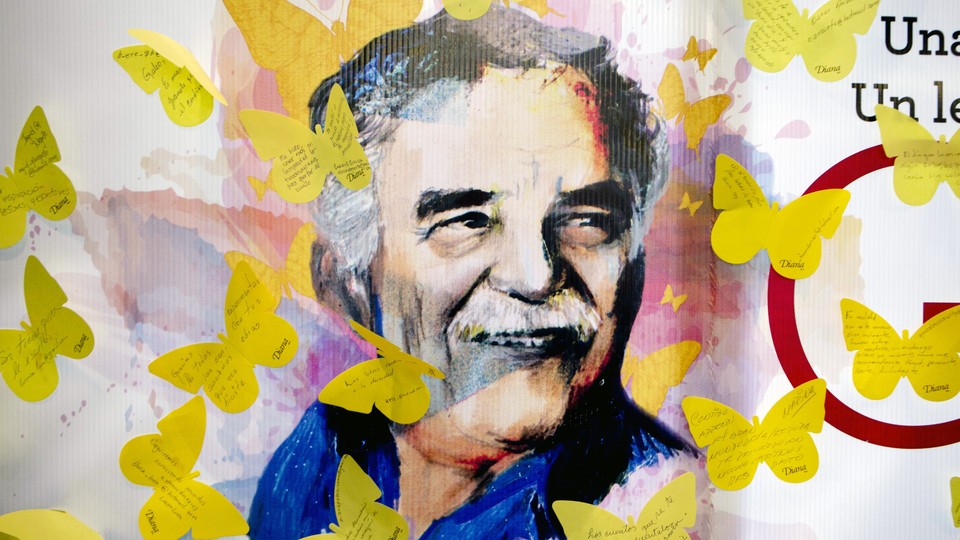
In 1967, Sudamericana Press published One Hundred Years of Confinement (Cien años de soledad), a novel written by a little known Colombian author named Gabriel García Márquez. Neither the writer nor the publisher expected much of the book. They knew, as the publishing behemothic Alfred A. Knopf one time put it, that "many a novel is dead the day it is published." Unexpectedly, One Hundred Years of Solitude went on to sell over 45 million copies, solidified its stature as a literary archetype, and garnered García Márquez fame and acclaim every bit one of the greatest Spanish-language writers in history.
Fifty years afterwards the book's publication, it may be tempting to believe its success was every bit inevitable as the fate of the Buendía family at the story'due south center. Over the course of a century, their boondocks of Macondo was the scene of natural catastrophes, civil wars, and magical events; information technology was ultimately destroyed after the last Buendía was built-in with a pig's tail, as prophesied by a manuscript that generations of Buendías tried to decipher. Only in the 1960s, 1 Hundred Years of Solitude was not immediately recognized as the Bible of the fashion now known equally magical realism, which presents fantastic events as mundane situations. Nor did critics agree that the story was really groundbreaking. To fully capeesh the novel's longevity, artistry, and global resonance, information technology is essential to examine the unlikely confluence of factors that helped it overcome a difficult publishing climate and the author's relative anonymity at the fourth dimension.
* * *
In 1965, the Argentine Sudamericana Press was a leading publisher of contemporary Latin American literature. Its acquisitions editor, in search of new talent, cold-called García Márquez to publish some of his work. The writer replied with enthusiasm that he was working on One Hundred Years of Solitude, "a very long and very circuitous novel in which I have placed my best illusions." Two and a half months before the novel'due south release in 1967, García Márquez's enthusiasm turned into fear. After mistaking an episode of nervous arrhythmia for a eye attack, he confessed in a letter of the alphabet to a friend, "I am very scared." What troubled him was the fate of his novel; he knew information technology could die upon its release. His fear was based on a harsh reality of the publishing industry for ascension authors: poor sales. García Márquez's previous four books had sold fewer than ii,500 copies in full.
The best that could happen to One Hundred Years of Confinement was to follow a path similar to the books released in the 1960s as part of the literary movement known equally la nueva novela latinoamericana. Success as a new Latin American novel would mean selling its small first edition of eight,000 copies in a region with 250 million people. Good regional sales would attract a mainstream publisher in Spain that would and then import and publish the novel. International recognition would follow with translations into English language, French, High german, and Italian. To striking the jackpot in 1967 was to likewise receive ane of the coveted literary awards of the Castilian language: the Biblioteca Breve, Rómulo Gallegos, Casa de las Américas, and Formentor.
This was the path taken by new Latin American novels of the 1960s such equally Explosion in a Cathedral by Alejo Carpentier, The Time of the Hero by Mario Vargas Llosa, Hopscotch by Julio Cortázar, and The Death of Artemio Cruz by Carlos Fuentes. 1 Hundred Years of Solitude, of form, eclipsed these works on multiple fronts. Published in 44 languages, it remains the near translated literary piece of work in Spanish afterward Don Quixote, and a survey amongst international writers ranks it as the novel that has most shaped world literature over the by three decades.
And yet it would be wrong to credit One Hundred Years of Confinement with starting a literary revolution in Latin America and across. Sudamericana published information technology when the new Latin American novel, past then popularly chosen the boom latinoamericano, had reached its superlative in worldwide sales and influence. From 1961 onward, similar a revived Homer, the most bullheaded Argentine writer Jorge Luis Borges toured the planet as a literary celebrity. Post-obit in his footsteps were rising stars like José Donoso, Cortázar, Vargas Llosa, and Fuentes. The international triumph of the Latin American Boom came when the Nobel Prize in Literature was awarded to Miguel Ángel Asturias in 1967. I Hundred Years of Solitude could non have been published in a better year for the new Latin American novel. Until then, García Márquez and his work were practically invisible.
* * *
In the decades earlier information technology reached its zenith, the new Latin American novel vied for attention alongside other literary trends in the region, Espana, and internationally. Its main contest in Latin America was indigenismo, which wanted to requite vocalisation to indigenous peoples and was supported by many writers from the 1920s onward, including a young Asturias and José María Arguedas, who wrote in Spanish and Quechua, a native language of the Andes.
In Espana during the 1950s and 1960s, writers embraced social realism, a fashion characterized past terse stories of tragic characters at the mercy of dire social weather condition. Camilo José Cela and Miguel Delibes were among its primal proponents. Latin Americans wanting a literary career in Spain had to comply with this manner, one example being a young Vargas Llosa living in Madrid, where he kickoff wrote social-realist short stories.
Internationally, Latin American writers saw themselves competing with the French nouveau roman or "new novel." Supporters, including Jean-Paul Sartre, praised it as the "anti-novel." For them, the goal of literature was not narrative storytelling, but to serve every bit a laboratory for stylistic experiments. The almost astonishing of such experiments was George Perec's 1969 novel A Void, written without ever using the letter "e," the most common in the French language.
In 1967, the book market place was finally set up, it seemed, for Ane Hundred Years of Solitude. By then, mainstream Latin American writers had grown tired of indigenismo, a style used past "provincials of folk obedience," as Cortázar scoffed. A young generation of authors in Espana belittled the stories in social-realist novels as predictable and technically unoriginal. And in France, emerging writers (such as Michel Tournier in his 1967 novel Vendredi) called for a return to narrative storytelling as the appeal of the noveau roman waned.
Between 1967 and 1969, reviewers argued that One Hundred Years of Solitude overcame the limitations of these styles. Opposite to the localism of indigenismo, reviewers saw Ane Hundred Years of Solitude as a cosmopolitan story, one that "could right the path of the modern novel," according to the Latin American literary critic Ángel Rama. Dissimilar the succinct language of social realism, the prose of García Márquez was an "atmospheric purifier," full of poetic and flamboyant linguistic communication, as the Spanish author Luis Izquierdo argued. And contrary to the formal experiments of the nouveau roman, his novel returned to "the narrative of imagination," as the Catalan poet Pere Gimferrer explained. Upon the book'southward translation to major languages, international reviewers acknowledged this, too. The Italian writer Natalia Ginzburg forcefully called One Hundred Years of Confinement "an alive novel," assuaging contemporary fears that the form was in crunch.
And yet these and other reviewers also remarked that One Hundred Years of Solitude was not a revolutionary work, but an anachronistic and traditionalist one, whose opening sentence resembled the "Once upon a time" formula of folk tales. And rather than a serious novel, it was a "comic masterpiece," as an bearding Times Literary Supplement reviewer wrote in 1967. Early views on this novel were indeed different from the ones that followed. In 1989, Yale literary scholar Harold Bloom solemnly called it "the new Don Quixote" and the writer Francine Prose confessed in 2013 that "I Hundred Years of Solitude convinced me to drib out of Harvard graduate schoolhouse."
Present scholars, critics, and general readers mainly praise the novel as "the best expression of magical realism." By 1995, magical realism was seen as making its fashion into the works of major English-linguistic communication authors such John Updike and Salman Rushdie and moreover presented as "an inextricable, ineluctable chemical element of human beingness," according to the New York Times literary critic Michiko Kakutani. But in 1967, the term magical realism was uncommon, fifty-fifty in scholarly circles. During One Hundred Years of Solitude'south first decade or so, to brand sense of this "unclassifiable work," every bit a reviewer put it, readers opted for labeling information technology as a mixture of "fantasy and reality," "a realist novel full of imagination," "a curious case of mythical realism," "suprarrealism,"or, as a critic for Le Monde called it, "the marvelous symbolic."
Now seen as a story that speaks to readers around the world, One Hundred Years of Confinement was originally received equally a story about Latin America. The Harvard scholar Robert Kiely called it "a South American Genesis" in his review for the New York Times. Over the years, the novel grew to have "a texture of its own," to utilise Updike'due south words, and information technology became less a story near Latin America and more than about flesh at large. William Kennedy wrote for the National Observer that information technology is "the beginning piece of literature since the Book of Genesis that should be required reading for the entire human race." (Kennedy besides interviewed García Márquez for a feature story, "The Yellow Trolley Automobile in Barcelona, and Other Visions," published in The Atlantic in 1973.)
Perhaps even more surprisingly, respected writers and publishers were amidst the many and powerful detractors of this novel. Asturias declared that the text of One Hundred Years of Solitude plagiarized Balzac's 1834 novel The Quest of the Absolute. The Mexican poet and Nobel recipient, Octavio Paz, chosen it "watery verse." The English writer Anthony Burgess claimed it could not be "compared with the genuinely literary explorations of Borges and [Vladimir] Nabokov." Espana's most influential literary publisher in the 1960s, Carlos Barral, not only refused to import the novel for publication, merely he also later wrote "it was not the best novel of its time." Indeed, entrenched criticism helps to make a literary piece of work like Ane Hundred Years of Solitude more than visible to new generations of readers and eventually contributes to its consecration.
With the help of its detractors, too, fifty years afterwards the novel has fully entered popular civilisation. It continues to be read around the globe, past celebrities such equally Oprah Winfrey and Shakira, and by politicians such as Presidents Bill Clinton and Barack Obama, who called the book "one of my favorites from the time I was immature."
More than recently, with the aid of ecologically minded readers and scholars, One Hundred Years of Solitude has unexpectedly gained renewed significance equally sensation of climate change increases. After the explosion of the BP drilling rig Deepwater Horizon in 2010 in the Gulf of Mexico (1 of the worst accidental environmental catastrophes in history), an environmental-policy advocate referred to the blowout as "tragic realism" and a U.South. journalist chosen it the "pig's tail of the Petro-Globe." What was the connexion with Ane Hundred Years of Confinement? The explosion occurred at an oil and gas prospect named Macondo by a group of BP engineers two years earlier, then when Deepwater Horizon blew up, reality defenseless upwardly with fiction. Some readers and scholars started to merits the spill revealed a prophecy like to the ane hidden in the Buendías manuscript: a warning nearly the dangers of humans' devastation of nature.
García Márquez lived to see the name of Macondo become part of a significant, if horrifying, part of earth's geological history, but not to celebrate the 50th ceremony of his masterpiece: He passed away in 2014. Merely the anniversary of his best known novel volition exist celebrated globally. As part of the commemoration, the Harry Ransom Center in Austin, Texas, where García Márquez'south athenaeum have been kept since 2015, has opened an online exhibit of unique materials. Among the contents will be the original typescript of the "very long and very circuitous novel" that did not die but attained immortality the twenty-four hour period information technology was published.
strongallontention.blogspot.com
Source: https://www.theatlantic.com/entertainment/archive/2017/05/one-hundred-years-of-solitude-50-years-later/527118/
0 Response to "Family in One Hundred Years of Solitude Essay"
Post a Comment