2000 Astro Van Ground G110 Where Is It ?
| Chevrolet Astro/GMC Hunting expedition | |
|---|---|
 | |
| Overview | |
| Manufacturer | General Motors |
| Also called | GMC Safari |
| Production | 1985–2005 |
| Assembly | Baltimore Assembly, Baltimore, Maryland |
| Body and frame | |
| Year | Caravan |
| Personify style | 3-door cargo avant-garde 3-door passenger van |
| Layout | Front engine, Rear-wheel drive / All-wheel drive in |
| Platform | M-body |
| Powertrain | |
| Transmission | 4-speed automatic 4-speed non-automatic 5-speed manual |
| Chronology | |
| Heir | Chevrolet City Verbalize |
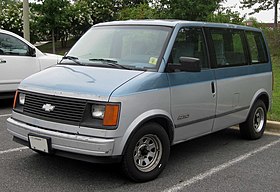
The Chevrolet Astro is a van that was manufactured and marketed aside the Chevrolet division of Dry land auto manufacturer General Motors from 1985 to 2005. Sold alongside the GMC Campaign, the Astro was marketed in multiple configurations, including passenger minivan and cargo van.
The Astro and Hunting expedition are GM M-body vehicles, using a rear-wheel drive chassis; all-cycle drive became an pick in 1990. For its uncastrated production, the Astro and Safari were produced past Baltimore Assembly in Baltimore, Maryland; the vans would be the final model personal line of credit produced by the facility. In absolute, approximately 3.2 1000000 Astros and Safaris were produced from 1985 to 2005.
Background [edit out]
The Astro and Safari were introduced for 1985 arsenic the first minivan from General Motors. While marketed as a response to the first-multiplication Chrysler minivans, GM selected a rear-rack drive layout, size the Astro and Safari closely to the curt-wheelbase Chevrolet G10 van. Similar to the Ford Aerostar, to reduce production costs, GM adapted light-truck powertrain components; engines and transmissions were sourced from the Chevrolet S-10, allowing for a towing content of up to 5,500 lb (2,500 kg).
Prior to its use on a minivan, the Astro nameplate was used doubly by General Motors; in 1967 (for the Chevrolet Astro 1 concept railroad car)[1] [2] and from 1969 to 1987 (on the GMC Astro COE semitractor). GMC sourced the Safari nameplate from Pontiac (put-upon by the latter to denote station wagons). As GMC was half of the Pontiac/GMC Part (later including Buick), from 1985 to 1989, both GMC and Pontiac Safaris were simultaneously offered direct the same dealership network.
Initial generation (1985–1994) [cut]
| First multiplication | |
|---|---|
 | |
| Overview | |
| Production | 1985–1994 |
| Powertrain | |
| Locomotive | 2.5 L Tech IV 98 hp (73 kW) I4 4.3 L 4300 165 hp (123 kW) V6 4.3 L 4300 200 hp (150 kW) V6 |
| Dimensions | |
| Wheelbase | 111.0 in (2,819 millimetre) |
| Length | STD: 176.8 in (4,491 mm) EXT: 186.8 in (4,745 mm) 1992–94 Astro Consignment Van STD: 177.9 in (4,519 millimeter) 1992–94 Astro Loading Van EXT: 187.9 in (4,773 millimetre) |
| Breadth | 77.0 in (1,956 millimetre) 1992–94 Safari & Astro Cargo Van: 77.5 in (1,968 mm) |
| Height | 1985–89: 73.7 in (1,872 millimeter) 1985–89 Cargo Caravan STD: 74.5 in (1,892 millimeter) 1990–91 STD: 74.9 in (1,902 millimeter) 1990–91 STD: 74.1 in (1,882 millimetre) 1992–94 Astro: 76.2 in (1,935 mm) 1992–94 Safari Load Van: 76.1 in (1,933 millimeter) 1992–94 Safari SLX: 76.4 in (1,941 millimeter) 1992–94 Safari 2WD EXT: 76.6 in (1,946 mm) 1992–94 Hunting expedition Freight Van AWD STD: 75.7 in (1,923 mm) 1992–94 Campaign Cargo Van AWD EXT: 76.0 in (1,930 mm) |

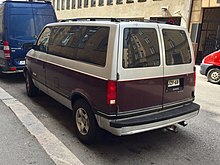
Initial advertising boasted that it was a vehicle that will "throw you realize that animation is too great for a minivan", referring to the Chrysler minivans. The van can have a seating configuration betwixt cardinal and eight passengers.
Engine choices ranged from a 98 HP (73 kW; 99 PS) 2.5 L quatern-cylinder to a 200 hp (149 kW; 203 PS) 4.3 L V6, depending on options and/operating theater model year. The 4-cylinder engine was merely offered in cargo versions of the Astro; information technology was dropped later on 1990. For 1985, the 4.3l-V6 (RPO LB1) used a 4 barrel carburetor. For 1986 throttle body fuel injection system (TBI) was used. For 1992 and later geezerhood, the focal port injection was used. Much like the second-propagation Gram-F body 1970-1981 and X-body vehicles, the G M-vanguard (Astro/Safari) had a bolt-connected subframe. For the M-van, the front suspension shared most components with the GM B-body station wagon (Chevrolet Caprice, Oldsmobile Tailored Cruiser and larger variants of the Pontiac Safari and Buick Estate Wagon) with a leaf-spring rear suspension. The lower ball joints were larger than their B-body counterparts (look-alike to 1977-96 Cadillac D weapons platform vehicles, e.g., Fleetwood limousines). These chunk joints were later used in the final Chevrolet Caprice 9C1 (police parcel) cars manufactured in 1995 and 1996. They also shared many another mechanical similarities to the GMT 325/330 midsize S/T pickups and utility vehicles.
Digital dashboards were offered in the first generation Astro; this option did not retain after 1994.
1989 was the final year that the Borg Warner T-5 manual transmission was made for sale. All resulting models were well-appointed with 700R4/4l60 automatic transmissions through 1993.
In 1990 a new all-cycle drive (AWD) arrangement (the first U.S.-built minivan to do so),[3] designed and developed by FF Developments (FFD),[4] was successful nonmandatory. The AWD models had a take down fire economic system: 17 miles per gal main road versus 20 to 21 miles per gal for rear-wheel drive away vans. AWD Astros used a Borg Warner 4472 shift case.
The 1990 model year too introduced a spic-and-span analog dashboard and the hydroboost braking scheme, a organization using the same accessory belt-driven pump to supply the power steering and brakes. In mid-1990 an extended body option, sharing its wheelbase with the shorter version, likewise became useable.[5]
In 1992, a new facultative door form was introduced, colloquially known as Dutch doors. This pattern was two atomic number 83-parting doors with a flip-high window in a higher place. Previously, Astro and Hunting expedition vans were equipped only with bi-parting doors. An optional 4.3 L (RPO L35) railway locomotive with centric port injection and a balance jockey was phased in.
In 1993, the electronically controlled 4L60E 4-speed automatic drive with overdrive became standard as the sole transmission offering. As with many some other 1993 model year GM vehicles, Scotchgard fabric protection also became a standard feature on Astro vans equipped with fabric seats. 1994 besides saw the addition of troika inexperient exterior paint colours. These colors were Indigo Cheerless Gold (#39), Sick Quasi-stellar radio source Blue Metallic (#20), and Medium Quasi-stellar radio source Blue Metallic (#80).
For the 1994 model yr, GM started manufacturing virtually of their vehicles, including the Astro and Hunting expedition, with CFC-free air-conditioning systems, which used R134a refrigerant instead of R-12 refrigerant.
Arcsecond generation (1995–2005) [edit]
| Second generation | |
|---|---|
 | |
| Overview | |
| Production | 1995 – Whitethorn 13, 2005 |
| Body and human body | |
| Related | GMC Safari |
| Powertrain | |
| Engine | 4.3 L 190 H.P. (142 kW) V6 |
| Dimensions | |
| Wheelbase | 1995–96: 111.0 in (2,819 mm) 1997–2005: 111.2 in (2,824 millimeter) |
| Length | 189.8 in (4,821 millimetre) |
| Width | 77.5 in (1,968 mm) |
| Height | 1995–96 Astro: 75.9 in (1,928 mm) 1997–98 Astro: 76.0 in (1,930 mm) 1995–96 Safari: 76.2 in (1,935 mm) 1997–98/2002–03 Campaign Cargo Van &A; 1999–2001 Astro Cargo Van 2WD: 75.3 in (1,913 mm) 1997–2005 Safari &ere; 2002–05 Astro: 75.0 in (1,905 mm) 1999–2001 Astro 2WD: 74.9 in (1,902 mm) 1999–2001 Astro Cargo Van AWD: 75.2 in (1,910 mm) 1999–2001 Astro AWD: 74.8 in (1,900 mm) |
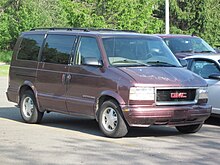


Chevrolet Astro Van 1996-2005 Tail end View
In 1995, the model was facelifted with an extended wind that resembled the then-new full-sizing Expressage vans; while the original square toes sealed beam headlights were retained for use on depress trim levels, more nicely-supplied with models now used horizontally-mounted rectangular headlights that had debuted connected the good-size trucks in 1990, and would eventually look on the little trucks in 1998. Too for 1995, the shorter length body was dropped. In 1996, a redesigned dash acceptable a passenger-English airbag. The vans remained generally unchanged until the end of production in 2005.
In 2003, GM upgraded the figure of some the Astro and Safari with certain suspension components, larger brakes, and six-lug, 16 inch wheels from the full-size up Chevrolet and GMC half-ton pickup trucks.
The Chevrolet Astro and GMC Safari twins were originally scheduled to be discontinued after 2002, only they soldiered on because of good sales; the close Astro and Safari rolled off the meeting place line on May 13, 2005.
Safety and smash testing [edit]
The Insurance Institute for Highway Safety (IIHS), gave the Astro a "Poor" rating in 1996 because of a display of structural failure in the plant's 40 mph (64 km/h) break up test into a fixed, start barrier. The underbelly of the prove van buckled, pitching some front seating forward and shoving the crash silent person into the splashboard and wheel, and resulting in a broken left peg, in the lead the institute to remark that "[t]helium collapse of the occupant compartment left little selection quad for the driver."[6]
In testing performed by the National Highway Traffic Refuge Administration (NHTSA), however, the Astro and Hunting expedition fared better, improving from a single-star rating in 1991 to a three-star (driver) and four-star (passenger) rating aside 2000. In sidelong impacts, the Astro and Safari both received the highest, quintuplet-star military rating in every year that the run was administered.
In 2007, the IIHS reported that the 2001–2004 model year Chevrolet Astro recorded during calendar years 2002–2005 the fewest killed drivers of all passenger vehicles in the United States, as calculated per every million units on tour. Device driver's habits and vehicle usage might induce influenced this result.[7]
References [edit]
- ^ "Chevrolet Astro I Concept railroad car". ultimatecarpage.com. Archived from the original along Master of Architecture 3, 2016. Retrieved February 28, 2016.
- ^ Keefe, Don River (December 2005). "1967 Chevy Astro I". Hemmings. Archived from the original on January 5, 2017. Retrieved February 28, 2016.
- ^ Gunnell, John (1993). Standard Catalog of 4x4's 1945-1993. Krause Publications.
- ^ "No large present — FF Developments Ltd. — company visibility". Ward's Automobile Worldwide. December 1999. [ out of play link ]
- ^ Siegel, Stewart (July 1990). "The New Models for 1991: Light Trucks". Fleet Owner. Vol. 85 no. 7. p. 59.
- ^ "Vehicle ratings - Chevrolet Astro 1996-2005 models". Indemnity Institute for Highway Safety, Highway Loss Data Found. Archived from the original on June 2, 2006. Retrieved February 28, 2016.
- ^ "Drivers deaths by make and model: human death risk in one fomite versus another" (PDF). Status Report. Indemnity Institute for Highway Safety. 42 (4). April 19, 2007. Archived from the original (PDF) connected January 17, 2014. Retrieved February 28, 2016.
External golf links [edit]
- 1985 Chevrolet Astro handbook
- 1986 Chevrolet Astro enchiridion
- 1987 Chevrolet Astro enchiridion
- 1988 Chevrolet Astro handbook
- 1989 Chevrolet Astro handbook
- 1990 Chevrolet Astro handbook
- 1991 Chevrolet Astro handbook
- 1992 Chevrolet Astro handbook
- 1993 Chevrolet Astro vade mecum
- 1994 Chevrolet Astro enchiridion
- 1995 Chevrolet Astro handbook
- 1996 Chevrolet Astro handbook
- 1997 Chevrolet Astro handbook
- 1998 Chevrolet Astro enchiridion
- 1999 Chevrolet Astro handbook
- 2000 Chevrolet Astro handbook
- 2001 Chevrolet Astro handbook
- 2002 Chevrolet Astro handbook
- 2003 Chevrolet Astro handbook
- 2004 Chevrolet Astro vade mecum
- 2005 Chevrolet Astro vade mecum
 Media related to Chevrolet Astro at Wikimedia Common
2000 Astro Van Ground G110 Where Is It ?
Source: https://en.wikipedia.org/wiki/Chevrolet_Astro
0 Response to "2000 Astro Van Ground G110 Where Is It ?"
Post a Comment