what is it like to work in an amazon warehouse
T he first detail I meet in Amazon'southward Swansea warehouse is a package of domestic dog nappies. The second is a massive pinkish plastic dildo. The warehouse is 800,000 square feet, or, in what is Amazon'southward standard unit, the size of 11 football pitches (its Dunfermline warehouse, the United kingdom'south largest, is 14 football pitches). It is a quarter of a mile from end to end. There is space, it turns out, for an awful lot of crap.
Merely then in that location are more than 100m items on its United kingdom of great britain and northern ireland website: if y'all can possibly imagine it, Amazon sells it. And if you lot can't possibly imagine it, well, Amazon sells it too. To spend 10½ hours a day picking items off the shelves is to contemplate the darkest recesses of our consumerist desires, the wilder reaches of stuff, the things that money can buy: a One Direction charm bracelet, a dog onesie, a cat scratching post designed to await like a DJ'due south record deck, a banana slicer, a fake twig. I work mostly in the outsize "not-conveyable" department, the home of diabetic dog food, and bio-organic vegetarian dog food, and obese domestic dog food; of 52in TVs, and six-packs of water shipped in from Fiji, and oversized sex toys – the 18in double dong (regular-sized sex toys are shelved in the sortables section).
On my second day, the director tells united states of america that nosotros alone accept picked and packed 155,000 items in the by 24 hours. Tomorrow, 2 December – the busiest online shopping day of the yr – that figure will be closer to 450,000. And this is just one of eight warehouses across the country. Amazon took 3.5m orders on a single day last yr. Christmas is its Vietnam – a test of its corporate mettle and the kind of challenge that would brand even the nigh experienced distribution supply managing director break down and weep. In the past two weeks, information technology has taken on an extra xv,000 bureau staff in Britain. And information technology expects to double the number of warehouses in U.k. in the next three years. It expects to go along the growth that has fabricated it one of the most powerful multinationals on the planet.
Correct now, in Swansea, four shifts volition exist working at least a fifty-hour calendar week, manus-picking and packing each particular, or, as the Daily Mail service put information technology in an commodity a few weeks ago, beingness "Amazon's elves" in the "21st-century Santa'due south grotto".
If Santa had a track record in paying his temporary elves the minimum wage while pushing them to the limits of the EU working time directive, and sacking them if they take iii ill breaks in whatever three-month menses, this would exist an apt comparison. It is probably reasonable to presume that tax abstention is not "constitutionally" a role of the Santa business organization model equally Brad Stone, the author of a new book on Amazon, The Everything Store: Jeff Bezos and the Age of Amazon , tells me information technology is in Amazon'due south instance. Neither does Santa endeavor to bang-up his competitors, as Mark Constantine, the founder of Lush cosmetics, who last week took Amazon to the high court, accuses it of doing. Santa was not called before the Commons public accounts committee and called "immoral" by MPs.
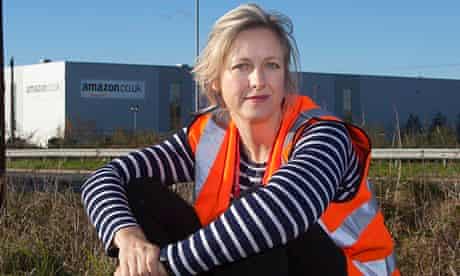
For a week, I was an Amazon elf: a temporary worker who got a job through a Swansea employment bureau – though it turned out I wasn't the but journalist who happened upon this thought. Last Monday, BBC's Panorama aired a programme that featured undercover filming from inside the aforementioned warehouse. I wonder for a moment if we have committed the ultimate media applesauce and the show's hole-and-corner reporter, Adam Littler, has secretly filmed me while I was secretly interviewing him. He didn't, simply it's not a coincidence that the estrus is on the world'south virtually successful online business concern. Considering Amazon is the future of shopping; being an Amazon "acquaintance" in an Amazon "fulfilment heart" – take that for doublespeak, Mr Orwell – is the future of work; and Amazon's payment of minimal revenue enhancement in any jurisdiction is the time to come of global business organisation. A future in which multinational corporations wield more power than governments.
Merely then who hasn't absent-minded-mindedly clicked at something in an idle moment at work, or while watching telly in your pyjamas, and, in what'due south a modest miracle of modern life, received a familiar brown cardboard package dropping on to your chump a day subsequently. Amazon is successful for a reason. It is brilliant at what it does. "It solved these huge challenges," says Brad Stone. "It mastered the chaos of storing tens of millions of products and figuring out how to become them to people, on fourth dimension, without neglect, and no one else has come up even close." We didn't just pick and pack more than 155,000 items on my beginning 24-hour interval. We picked and packed the correct items and sent them to the right customers. "We didn't miss a single club," our section director tells us with proper pride.
At the stop of my starting time twenty-four hour period, I log into my Amazon account. I'd left my mum's house outside Cardiff at 6.45am and got in at 7.30pm and I want some Compeed cicatrice plasters for my toes and I can't practice it before work and I tin't do information technology after work. My finger hovers over the "add to basket" option but, instead, I wait at my Amazon history. I made my first purchase, The Rough Guide to Italy, in February 2000 and remember that I'd bought it for an commodity I wrote on booking a holiday on the internet. It's so quaint reading information technology now. It'due south from the age before broadband (I itemise my phone bill for the day and it cost me £25.x), when Google was in its infancy. It's littered with the names of defunct websites (recollect Sir Bob Geldof'south deckchair.com, anyone?). It was a frustrating job and of pretty much everything I ordered, only the book turned upwards on time, equally requested.
Only then information technology's a astounding operation. And to work in – and I find it hard to type these words without suffering irony seizure – a "fulfilment centre" is to be a tiny cog in a massive global distribution auto. It'south an industrialised procedure, on a truly massive scale, made possible past new engineering science. The place might expect similar it's been stocked at 2am past a drunk shelf-filler: a typical shelf might take a set of razor blades, a packet of condoms and a My Piffling Pony DVD. And yet everything is systemised, considering it has to be. It's what makes information technology all the more unlikely that at the heart of the operation, shuffling items from stowing to picking to packing to shipping, are those mankind-shaped, not-always-reliable, prone-to-malfunctioning things we know as people.
Information technology'due south here, where bodily people rub upwardly confronting the business demands of one of the nearly sophisticated technology companies on the planet, that things get messy. It's a system that includes unsystemisable things like hopes and fears and plans for the future and children and lives. And in places of high unemployment and low economic opportunities, places where Amazon deliberately sites its distribution centres – it received £eight.8m in grants from the Welsh regime for bringing the warehouse hither – despair leaks effectually the edges. At the interview – a form-filling, drug- and alcohol-testing, general-checking-you-tin-read session at a local employment agency – we're shown a video. The process is explained and a pick of people are interviewed. "Like you, I started as an agency worker over Christmas," says one man in it. "But I quickly got a permanent job then promoted and now, two years subsequently, I'm an surface area manager."
Amazon will be taking people on permanently subsequently Christmas, we're told, and if you piece of work hard, you lot can be ane of them. In the Swansea/Neath/Port Talbot expanse, an area still suffering the body blows of Uk'south post-industrial refuse, these are powerful words, though information technology all starts to unravel pretty quickly. There are 4 agencies who have supplied staff to the warehouse, and their reps work from desks on the warehouse floor. Walking from one training session to another, I enquire one of them how many permanent employees work in the warehouse but he mishears me and answers another question entirely: "Well, evidently not everyone will exist taken on. Just look at the numbers. To be honest, the agencies have to say that just to go people through the door."
It does that. It'due south what the majority of people in my induction group are later. I train with Pete – non his existent name – who has been unemployed for the past 3 years. Before that, he was a intendance worker. He lives at the top of the Rhondda Valley, and his partner, Susan (non her existent name either), an unemployed It repair technician, has likewise but started. It took them more an hr to get to work. "We had to become the kids up at five," he says. After a 10½-hour shift, and almost another hour's drive back, before picking upward the children from his parents, they got home at 9pm. The adjacent twenty-four hour period, they did the same, except Susan twisted her ankle on the offset shift. She phones in but she will receive a "point". If she receives iii points, she will exist "released", which is how you get sacked in modern corporatese.
Then in that location'due south "Les", who is one of our trainers. He has a special, coloured lanyard that shows he'southward an Amazon "administrator", and some other that says he's a starting time aider. He's worked at the warehouse for more than than a year and over the form of the calendar week I run across him, speeding beyond the flooring, going at least twice the rate I'm managing. He's in his 60s and tells me how he lost two stone in the first two months he worked in that location from all the walking. We were told when we applied for the jobs that we may walk up to 15 miles a shift. He'd been a senior manager in the same house for 32 years earlier he was made redundant and landed up here. How long was it before you got a permanent task, I inquire him. "I haven't," he says, and he holds up his green ID badge. Permanent employees have blue ones, a amend hourly charge per unit, and subsequently ii years share options, and at that place is a subtle apartheid at piece of work.
"They dangle those blue badges in front of you," says Bill Woolcock, an ex-employee at Amazon's fulfilment centre in Rugeley, Staffordshire. "If you take a bluish bluecoat you have better wages, proper rights. Y'all can be working aslope someone in the same job, but they're stable and you're only cannon fodder. I worked at that place from September 2011 to February 2012 and on Christmas Eve an bureau rep with a clipboard stood by the go out and said: 'You're back after Christmas. And you're back. And you're not. You're non.' Information technology was simply brutal. It reminded me of stories about the great low, where men would stand up at the factory gate in the promise of being selected for a few days' labour. You but experience you accept no personal value at all."
Why haven't they given you a proper job, I inquire Les, and he shrugs his caput but elsewhere people mutter: it's friends of the managers who get the jobs. It's Hr picking names at random. It'southward some sort of blackness magic nobody understands. Walking off shift in a great wave of orangish loftier-vis vests, I chat to another homo in his 60s. He'd been working in the Unity mine, about Neath, he told me, until a month ago, the second fourth dimension he'd been laid off in two years. He'd worked at Amazon last Christmas also. "And they just allow me become directly later on, no warning or anything. And I couldn't have worked any harder! I worked my socks off!"
When I put the question to Amazon, it responded: "A small-scale number of seasonal associates have been with united states of america for an extended period of fourth dimension and nosotros are not bad to retain those individuals in order that nosotros can provide them with a permanent part when one becomes available. We were able to create 2,300 full-fourth dimension permanent positions for seasonal associates in 2013 by taking advantage of Christmas seasonality to find great permanent employees just, unfortunately, we simply cannot retain 15,000 seasonal employees."
And this is what Amazon says near its policy relating to sickness: "Amazon is a visitor in growth and nosotros offering a high level of security for all our associates. Like many companies, we employ a system to record employee attendance. We consider and review all personal circumstances in relation to whatever attendance bug and we would not dismiss anyone for beingness ill. The current systems used to record employee attendance is fair and predictable and has resulted in dismissals of 11 permanent employees out of a workforce of over 5,000 permanent employees in 2013."
It's worth noting that bureau workers are non Amazon employees.
There's no dubiety that it is difficult, concrete work. The Panorama documentary majored on the miles that Adam walked, the blisters he suffered, the ridiculous targets, and the fact that you're monitored by an Orwellian handset every second of every shift. As an agency worker, you're paid 19p an 60 minutes over the minimum wage – £6.50 – and the shifts are 10½ hours long. But lots of jobs involve hard, physical work. That's not the thing that bothers people. Almost everybody remains stoical in the confront of physical discomfort and burnout. And they're Welsh: in that location's a warmth and friendliness from nigh everyone who works there. My squad leader is no corporate droid. He started on the store floor, sounds similar Richard Burton, and is gently encouraging. And still.
"I've worked everywhere," a forklift truck commuter tells me. "And this is the worst. They pay shit because they can. Because in that location's no other jobs out at that place. Trust me, I know, I tried. I was working for £12 an hour in my last task. I'm getting £8 an hour hither. I worked for Sony before and they were strict but fair. It'southward the unfairness that gets you here."
An unfairness that has no outlet. In the wake of the BBC documentary, Hywel Francis, the MP for Aberavon, managed to get a meeting terminal week with Amazon'south manager of public policy, a coming together he's been trying to go for years. He's reluctant to speak virtually the complaints he'southward heard from his constituents but says that "the institute is infrequent in the local expanse in having no wedlock representation. Information technology's been a long booty to even get in at that place and find out what is going on." Information technology's been a black pigsty where the lack of any checks upon its ability has left a sense that everything is pared to the absolute bone – from the cheapest of the cheap plastic safety boots, which near long-term employees seem to spend their ain money replacing with something they can walk in, to the sack-you-if-y'all're-ill policy, to the xv-minute break that starts wherever you happen to be in the warehouse. On my third forenoon, at my lowest point, when my free energy has run out and my spirits are low, information technology takes me six minutes to walk to the airport-style scanners, where I spend a minute being frisked. I queue a minute for the loos, get a banana out of my locker, sit downwardly for 30 seconds, so I get up and walk the six minutes back to my station.
To work at Amazon is to spend your days at the coalface of consumerism. To witness our lust for stuff. This yr's stuff includes slap-up piles of Xboxes and Kindles and this season's Jamie Oliver cookbook, Save With Jamie (yous want to relieve with Jamie? Don't purchase his sodding volume), and Paul Hollywood's Pies & Puds, and Rick Stein'due south India.
The celebrity chef cookbooks incense me. They don't even bother taking them out of the boxes. They lie in great European union butter mount-sized piles at the ends of the aisle. Cook an egg on the idiot box and it's like being given a licence to print coin for all eternity. The vast majority of people working in the warehouse are white, Welsh, working class, just I railroad train with a man who's not called Sammy, and who isn't an asylum seeker from Sudan, but another state, and I spend an afternoon explaining to him what the scanner means when it tells him to look for a Skillful Boy Luxury Dog Stocking or a Gastric Mind Band hypnosis CD.
Information technology'south the Barbie Doll daughter'due south Christmas advent calendar, all the same, that nearly breaks me. I traipse dorsum and forth to section F, where I piece open a box, take some other Barbie advent calendar, unpick the box and put it on the recycling pile, put the agenda, which has been shipped from Red china, passed from the container port to a third-political party benefactor and from there to the Amazon warehouse, on to my trolley and pass it to the packers, where it will be repackaged in a different box and finally reach its ultimate destination: the joy in a modest kid's eye. Considering nothing captures the magic of Christmas more than a motion picture of a pneumatic blonde carrying multiple shopping bags. You can't put a price on that (£9.23 with free delivery).
Nosotros want cheap stuff. And we want to order information technology from our armchairs. And we want it to be delivered to our doors. And it'south Amazon that has worked out how to exercise this. Over fourth dimension, like a hardened drug user, my Amazon habit has increased. In 2002, I ordered my offset non-book item, a This Life series 1 video; in 2005, my kickoff not-Amazon production, a secondhand copy of a biography of Patricia Highsmith; and in 2008, I started doing the online equivalent of injecting intravenously, when I bought a TV on the site. "We are the about customer-axial company on earth," we're told in our induction briefing, before long before it'southward explained that if nosotros're late we'll get half a point, and subsequently three of them we're out. What constitutes tardily, I ask. "A minute," I'm told.
I grew up in South Wales and saw showtime-hand how the 1980s recession slashed a savage gash through everything, including my ain extended family. I've always known that at that place's only a tissue-sparse piece of luck betwixt very different sorts of lives. But then my grandfather worked in a warehouse in Swansea. In my case, there really is only a tissue-sparse piece of luck between me and an Amazon life. I take a lot of fourth dimension to retrieve about this during my ten½-hr day.
At the Neath working men's gild down the route, one of the staff tells me that Amazon is "the employer of last resort". It's where you get a task if you tin't get a job anywhere else. And information technology'southward this that's so heartbreaking. What did yous do earlier, I inquire people. And they say they're builders, hospitality managers, marketing graduates, Information technology technicians, carpenters, electricians. They owned their own businesses, and they were made redundant. Or the business went bosom. Or they had a stroke. Or their contract ended. They are people who had skilled jobs, or professional jobs, or only amend-paying jobs. And now they piece of work for Amazon, earning the minimum wage, and most of them are grateful to have that.
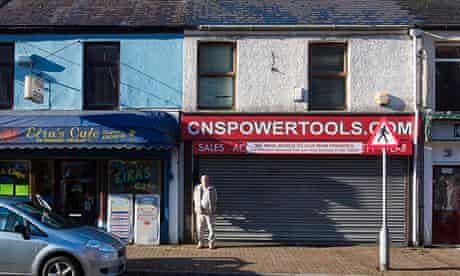
Amazon isn't responsible for the wider economy, just information technology's the wider economy that makes the Amazon model so chilling. It's not only the nicey nice jobs that are becoming endangered, such as working in a bookshop, equally Hugh Grant did in Notting Loma, or a tape shop, as the hero did in Nick Hornby's High Allegiance, or the jobs that have gone at Borders and Woolworths and Jessops and HMV, it's pretty much everything else too. Next in line is everything: working in the shoe department at John Lewis, or behind the tills at Tesco, or doing their Hour, or auditing their accounts, or building their websites, or writing their corporate magazines. Swansea'southward shopping centre down the road is already a planning disaster; a wasteland of charity shops and what Sarah Rees of Cover to Cover bookshop calls "a 2nd-rate Debenhams and a third-rate Marks and Spencer".
"People know virtually their employment practices, and all the delivery men hate them, just do people call up that when they click? Probably non. We try and kill them with kindness," she says. "You can't put the genie dorsum in the bottle." But and then at that place is nothing else to attempt and impale them with. It's cheaper, often for her, to order books on Amazon than through her benefactor. "We're upfront about information technology and tell people, but in that location is just no style to compete with them on cost."
In that location is no end to Amazon's appetite. "It's expanding in every believable direction," Brad Rock tells me. "It'south why I called my book The Everything Store. Their ambition is to sell everything. They already have their digital services and their enterprise services. They've just started selling art. Apparel is still very immature and is set for expansion. Groceries are the side by side big affair. They're going very strongly after that considering it will cut down costs elsewhere. If they tin start running their own trucks in major metro areas, they tin cut down the costs of third-party shippers."
In the UK, I indicate out, everyone already delivers groceries: Tesco, Asda, Waitrose, Sainsbury'south. "I suspect they'll acquire," he says. And everywhere it kills jobs. Shops employ 47 people for every $10m in sales, co-ordinate to research washed by a company called ILSR. Amazon employs merely xiv people per $10m of acquirement. In Britain, it turned over £iv.2bn last year, which is a net loss of 23,000 jobs. And fifty-fifty the remaining jobs, the hard, desperately paid jobs in Amazon'southward warehouses, are hardly future-proof. Amazon has just bought an automated sorting organisation called Kiva for $775m. How many retail jobs, of any description, will there be left in ten years' fourth dimension?
Our animalism for cheap, discounted appurtenances delivered to our doors promptly and efficiently has a price. We merely haven't worked out what it is nonetheless.
It's taxes, of course, that pay for the roads on which Amazon's delivery trucks drive, and the schools in which its employees are educated, and the hospitals in which their babies are born and their arteries are patched upwardly, and in which, one twenty-four hours, they may be nursed in their dying days. Taxes that all its workers pay, and that, it emerged in 2012, it tends not to pay. On Great britain sales of £4.2bn in 2012, it paid £iii.2m in corporation tax. In 2006, information technology transferred its UK business organization to Luxembourg and reclassified its U.k. performance every bit merely "guild fulfilment" business. The Luxembourg office employs 380 people. The UK operation employs 21,000. You do the math.
Brad Stone tells me that revenue enhancement avoidance is congenital into the company'south Dna. From the very beginning it has been "constitutionally oriented to securing every possible advantage for its customers, setting the lowest possible prices, taking advantage of every known taxation loophole or creating new ones". It'due south something that Mark Constantine, the co-founder of Lush cosmetics, has spent time thinking about. He refuses to sell through Amazon, just it didn't cease Amazon using the Lush proper noun to directly buyers to its site, where information technology suggested alternative products they might like.
"It'southward a way of bullying businesses to use their services. And we refused. We've been in the loftier court this week to sue them for alienation of trademark. It'southward cost united states of america half a million pounds then far to defend our business. Most companies just can't beget that. Merely we've done it because it'due south a matter of principle. They keep on forcing your hand and yet they don't have a viable concern model. The just way they can afford to run it is by not paying taxation. If they had to carry in a more conventional style, they would struggle.
"Information technology's a course of piracy capitalism. They rush into people'due south countries, they have the money out, and they dump it in some port of convenience. That'south not a business organisation in whatsoever traditional sense. It'south an ugly render to a form of exploitative commercialism that we had a century agone and we decided every bit a society to move on from."
In Swansea I chat to someone whose name is not Martin for a while. It's Saturday, the sun is shining and the warehouse has gone tranquility. We've been told to terminate picking. The orders have been turned off similar a tap. "It's the weather," he says. "When it rains, information technology tin can of a sudden go mental." We clear away boxes and the tax event comes up. "In that location was a lot of anger here," he says. "People were very biting about information technology. Only I'd always say to them: 'If someone told you that you could pay less taxation, exercise you honestly think you would volunteer to pay more?'" He's right. And the people who were angry were also right. It's an unignorable fact of modern life that, as Stuart Roper of Manchester Business School tells me, "some of these large brands are more than powerful than governments. They're wealthier. If they were countries, they would be pretty large economies. They're multinational and the global financial state of affairs allows them to ship money all over the earth. And the authorities is so desperate for jobs that it has given away large elements of control."
It's a mirror image of what is happening on the shop floor. Only every bit Amazon has eroded 200 years' worth of workers' rights through its employ of agencies and rendered a large swath of its workers powerless, so it has pulled off the aforementioned pull a fast one on with corporate responsibility. MPs like to slag off Amazon and Starbucks and Google for non paying their taxes but they've still to actually create the legislation that would compel them to do so.
"They are taking these massive subsidies from the state and they are non paying back," says Martin Smith of the GMB union. "Their argument is that they are creating jobs but what they are doing is displacing and replacing other jobs. Better jobs. And high street shops tend to pay their taxes. In that location is a £120bn revenue enhancement gap that is merely possible considering the authorities pay taxation benefits to enable people to survive. When companies pay the minimum wage they are in effect being subsidised by the taxpayer."
Back in Swansea, on the terminal pause of my last twenty-four hour period, I sit and chat with Pete and Susan from the Rhondda and Sammy, the asylum seeker from Sudan. Susan still wants a permanent task only is looking more hundred-to-one nearly it happening. Her ankle is notwithstanding swollen. Her pick rate has been low. Nosotros've been told that next week, the hours will increment by an hour a day and there will be an extra day of compulsory overtime. It will mean getting their children up by iv.30am and Pete is worried almost finding a baby-sitter at three days' notice. When I ask Sammy how the job compares with the one he had in Sudan, where he was a foreman in a manufactory, he thinks for a minute then shrugs: "It's the same."
There have ever been rubbish jobs. Ian Brinkley, the director of the Piece of work Foundation, calls Amazon'south employment practices "old wine in new bottles". Restaurants and kebab shops accept done the same sort of thing for years. But Amazon is not a kebab shop. Information technology'south the future. Which may or may non be something to recollect about every bit you click "add to basket".
strongallontention.blogspot.com
Source: https://www.theguardian.com/technology/2013/dec/01/week-amazon-insider-feature-treatment-employees-work
0 Response to "what is it like to work in an amazon warehouse"
Post a Comment